Experience
Night Game Drives
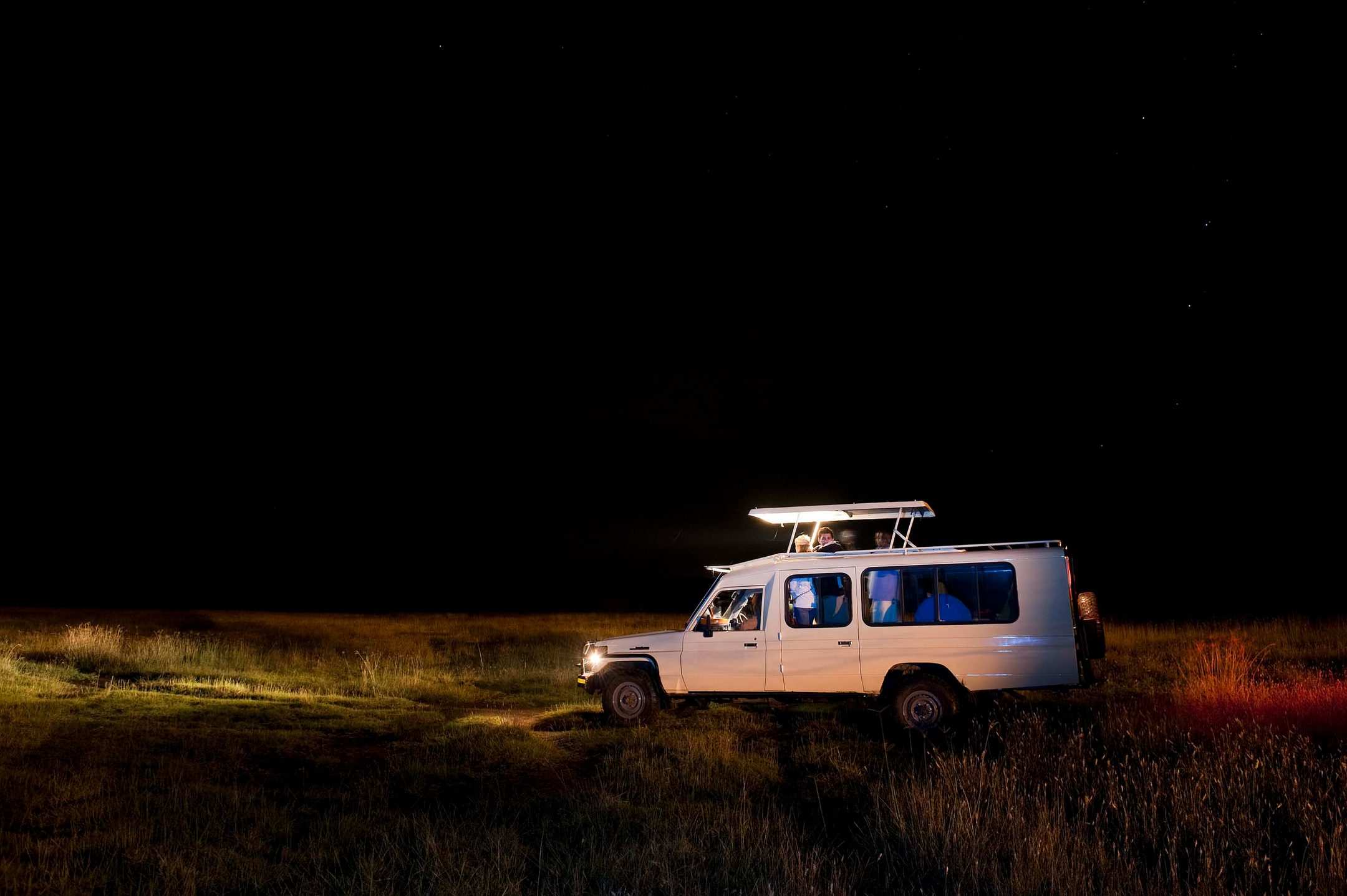
An hour or two after dinner in an open vehicle behind a red-filtered spotlight, out on a conservancy where driving after dark is allowed, looking for the animals that sleep through the daylight hours.
You go out after dinner, which is the first odd part of it. Same vehicle you sat in all afternoon, same guide. Someone hands you a blanket as you climb in, because it is colder than anyone warns you, and then the camp lights go behind you and there is nothing at all.
A night safari runs on one lamp. A spotter works it from the back, usually red-filtered, and it sweeps slowly across ground you drove over at four o’clock and did not look at twice. What it finds first is never an animal. It is two points of light floating at the wrong height, and the animal arrives a second later, when your eyes have caught up with them.
The roster changes completely after dark. Bat-eared foxes hunting in pairs. Genets and civets crossing the track and stopping halfway. Porcupines, usually gone by the time the lamp holds them. Bushbabies somewhere up in the acacias, sounding like an argument in a nursery. Aardvark if the guide is patient and you are very lucky. The animals you already saw are different animals now: lions that lay flat all afternoon are up and working, and a leopard at night is not the leopard folded over a branch in your photographs.
Then there is where you are allowed to do this. Night driving is generally not part of what Kenya’s national parks permit, since their gates and their rules are built around daylight, while the private conservancies alongside them set their own, and many run night drives as a matter of course. That is a large part of why we put people on a conservancy bed rather than a park lodge: Ol Pejeta and the wider Laikipia conservancies, the Mara conservancies like Naboisho, the ranches out past Samburu. Which of them runs drives on your dates, and under what conditions, is something we confirm with the camp rather than something we publish.
We sell the other night safari as well, Singapore’s, where the barriers are hard to find and the lighting is engineered to imitate a moon. It is genuinely good, and it is the rehearsal. This is the version where nothing is lit for your benefit and nobody knows what is out there. The Kenya destination page sets out which regions have the conservancies to do it from.
Good to know
- Whether a camp runs night drives, what it charges for them and what the current rules allow are set by the conservancy and change. We confirm for your dates rather than assume.
- Minimum ages are common and vary by property. We check them against your party before anything goes in an itinerary.
- It gets cold fast in an open vehicle at altitude. Take more than the blanket they hand you.
- The guide runs the lamp, and there is a reason it is filtered. Leave your own torch in the tent.
- One drive on a stay is usually the right number. It is an hour or two after dinner, not a replacement for the morning.
Which conservancies and camps run night drives, what the rules currently are inside and outside the national parks, whether a drive is included in a stay or charged separately, the timings on any given night, the minimum ages, and each property's own spotlight and off-road etiquette are all set by the conservancy or the camp and change. We confirm what applies to your dates in writing before you pay anything.
The eyes come back at you long before the animal does.
Where to do it
Where we arrange night game drives
Start from the destination, and we will build the days around this.
Or browse every itinerary andthe rest of the experiences.
Questions we are actually asked
Are you guaranteed to see anything?
Can children come?
Can we photograph it?
How does it fit into the day?
Keep reading
Where to go next
Each of these answers one of the questions this page opens.
Ask us about night game drives
Dates and how many of you is enough to start. We reply within one working day.
Thank you, it’s with us.
A travel designer will reply within one working day, usually sooner. Prefer to talk now? WhatsApp us on +254 722 354 333.
Your reference is . Quote it if you write again.
Plan your night game drives
One WhatsApp thread and one travel designer on it, start to finish.