The comparison
Road or flying?
Two ways of getting between the parks, and the honest differences between them. Not which one is better, but which one is better for the trip you are actually taking.
Anyone who answers this in one sentence has not asked how many of you there are or how long you have got, and those two numbers decide most of it. What follows is that arithmetic drawn out: who is in the vehicle, what each way costs one traveller and what it costs the party, how much of a week you spend in a park, and what you are allowed to bring. Where we would actually start on the phone is the grid near the bottom.
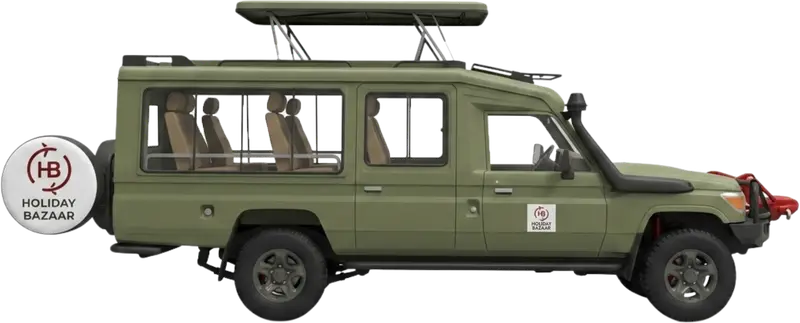
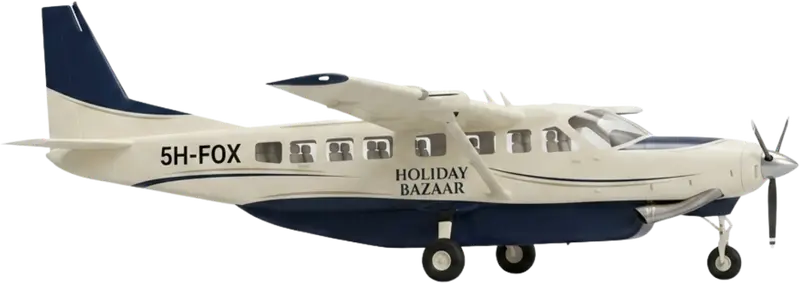
Private vehicle · yours all tripCamp's vehicle · shared under six
By road
The country counts
One vehicle and one driver-guide for the whole trip. The Rift Valley, the tea and the towns are part of it rather than something you fly over.
Game-viewing daysThree of seven
Between parksHalf a day
Flying
The parks count
Fifty minutes instead of six hours. You trade the country in between for two more days of game viewing, and about a third of your luggage.
Game-viewing daysFive of seven
Between parksUnder an hour
Road and flying compared
- Getting there
- By road: Half a day between parks, with the country going past the window
- Flying: Under an hour to most airstrips, from Wilson Airport in Nairobi
- What you see in between
- By road: The Rift Valley escarpment, the tea and the towns, which is the trip either side of the parks
- Flying: The country from three thousand feet, and then nothing until you land
- Your vehicle
- By road: Yours for the whole trip, and we seat six in it whatever the car will take
- Flying: The camp’s vehicle at the far end, shared with other guests unless you are six
- Your guide
- By road: One guide from Nairobi to the last park, who learns what you want to see
- Flying: A new guide at each camp, each of them deep in their own piece of country
- Cost
- By road: The lower of the two, and the gap widens with party size
- Flying: Higher, because you pay for the seat and usually for a smaller camp beside the strip
- Luggage
- By road: Whatever fits, within reason: every bag rides in the back, and a pop-top roof leaves no rack
- Flying: 23kg in a soft bag, no hard cases and no wheeled frames, plus one personal item
- Best for
- By road: Ten nights or more, families, groups, and anyone who wants the journey to count
- Flying: Short trips, honeymoons, and itineraries that reach two distant regions in one week
One
Who is in the vehicle
The Land Cruiser will take six or seven. We seat six, because that is what makes a week in it comfortable, and at six the vehicle is private however you arrived. Travel as fewer than six and fly in, and the camp vehicle meeting you at the airstrip may have other guests already in it. The seat plan at the top of this page is drawn for the number you pick; this is what its marks mean.
Your partyOne filled seat for each of you, up to six.
A seat we cannot promiseEmpty in your own vehicle. On a fly-in trip the camp may fill it.
The driver-guideNever one of the six, on either sort of trip.
Change the number travelling in the panel at the top of this page and the seats follow it. Six is where we stop, and it is a house rule rather than a limit: the vehicle will take six or seven. Six travelling therefore means a private vehicle whichever way you arrived. Under six on a fly-in trip, the vehicle waiting at the airstrip belongs to the camp, and you may be sharing it.
Two
What it costs each of you
A vehicle and a guide are bought once and then divided between however many of you climb in. A bush seat is bought again for every traveller. So the road line falls away as the party grows and the flying line does not move at all.
Three
What it costs the whole party
The same arithmetic from the other end. The road bar is the same height however many of you there are, because the car and the driver-guide do not get more expensive when more people sit in them; the flying total climbs one seat at a time.
Four
What a week actually holds
Seven nights is not seven days in a park either way. Drive, and three of them are game days and four are spent moving; fly, and it is five and two. A transfer day is not a wasted day, and the escarpment is a reason people drive in the first place, but it is not a day in a park either.
By road
Flying in
The same 7-night trip, split two ways. A transfer day is not a wasted day. The escarpment, the tea and the Rift are the reason some people drive in the first place. But it is not a day in a park either, and this is the trade in its plainest form: fly and the week holds five good days rather than three.
Five
What you can bring
One side of this is an airline specification and the other is a judgement, and they are deliberately not the same shape. Flying means a soft bag, 23kg, plus one personal item. Driving means whatever fits, within reason, which is a smaller sentence than whatever fits.
Flying in: a specification
- Weight
- 23kg, roughly 50lb
- Shape
- Soft-sided bag only. No hard cases, no wheeled frames.
- Plus
- One personal item.
We confirm the allowance for your specific flights in writing before you pack.
By road: a judgement
Whatever fits, within reason.
Which is a real limit, not a generous one. With six aboard, every bag goes in the back, and there is no roof rack to fall back on because the roof pops up.
These two sides do not match, and that is the honest shape of it: one is a number an airline sets, the other is a space and a judgement. Anyone quoting you a kilo figure for a road safari is guessing.
Six
Where the pattern breaks
Every other block on this page splits into two columns, road on one side and flying on the other. This one refuses to, because open sides are the lodge's decision and not a consequence of how you got there.
Seven
What we would say on the phone
Trip length down the side, party size across the top, and the position we would open with in each of the twelve squares. It is a lean rather than a rule, and the longest trips stop choosing altogether.
| Trip length | 1–2 travellingleans flying | 3–4 travellinghonestly either | 5–6 travellingleans road |
|---|---|---|---|
| 4–5 nights | Fly itTwo people paying for a whole vehicle is an expensive way to spend a short week. | Lean flyingOn a trip this short the transfer days cost you more than the seats do. | Drive itSix air seats bought to save one day is the most expensive day of the trip. |
| 6–8 nights | Fly itThe extra nights buy game days, and for two the seats still undercut the vehicle. | Honestly eitherThe square where the arithmetic genuinely ties. Decide on temperament, not on cost. | Drive itA vehicle divided by six is where the road stops competing and simply wins. |
| 9–12 nights | Fly, mostlyLong enough that one driven leg earns its place. The rest is only distance. | Lean roadThe vehicle divided by four gets cheaper every extra day you keep hold of it. | Drive, mostlyWith a single leg flown where the map is nothing but kilometres. |
| 13 nights or more | Do bothAt this length the country in between stops being a cost and becomes a reason. | Drive itLong trips are where one guide who already knows you pays you back. | Do bothLong enough that the coast hop is worth flying and everything else is worth driving. |
leans flying honestly either leans road
The tint is the lean of the whole column, not the verdict of the cell, which is why the flying column and the road column both end on do both. Read the words. And read them as what we would say on the phone: a starting position, not a rule, because a photographer with kit and a family with a five-year-old will get different answers out of the same square.
Eight
Most good trips do both
The binary the last seven blocks have been building is not really one. Drive the leg that is worth driving and fly the leg that is only distance. That is what most of the itineraries we are proudest of actually do.
- Nairobi
- Rift Valley
- Maasai Mara
- The coast
Nairobi to the Rift Valley to the Maasai Mara is driven. The Maasai Mara to the coast is flown.
driven flown
Questions we are actually asked
Choice-shaped ones. How each mode works on its own is answered on its own page.
We are six. Does that change the answer?
Is a fly-in camp automatically the better camp?
Do we get the same guide either way?
We photograph seriously. Does one of them get us a better vehicle?
At what group size does driving win on cost?
Keep reading
The two pages this one compares
This page is the choice. The detail, the routes we drive and how a bush flight actually works from Wilson Airport, lives on the two mode pages, and each of them argues its own side on purpose.
- Road safarisThe country between the parks, and what a driving day is like.
- Flying safarisWilson Airport, bush strips, and what the seat buys you.
- Safari vehiclesPop-top or open-sided, and which one you will get.
- What a Kenya safari costsReal rates from our own tables, not a range copied off a blog.
- Your first safariWhat a safari actually is, and how to choose your first one.
- Every itineraryTwenty-seven trips, each of them rebuilt around your dates.
Tell us the dates and how many of you
Those two numbers answer most of this page. We will price your route both ways and say which one we would book. A reply within one working day.