Destination
Oman holidaysfrom Nairobi
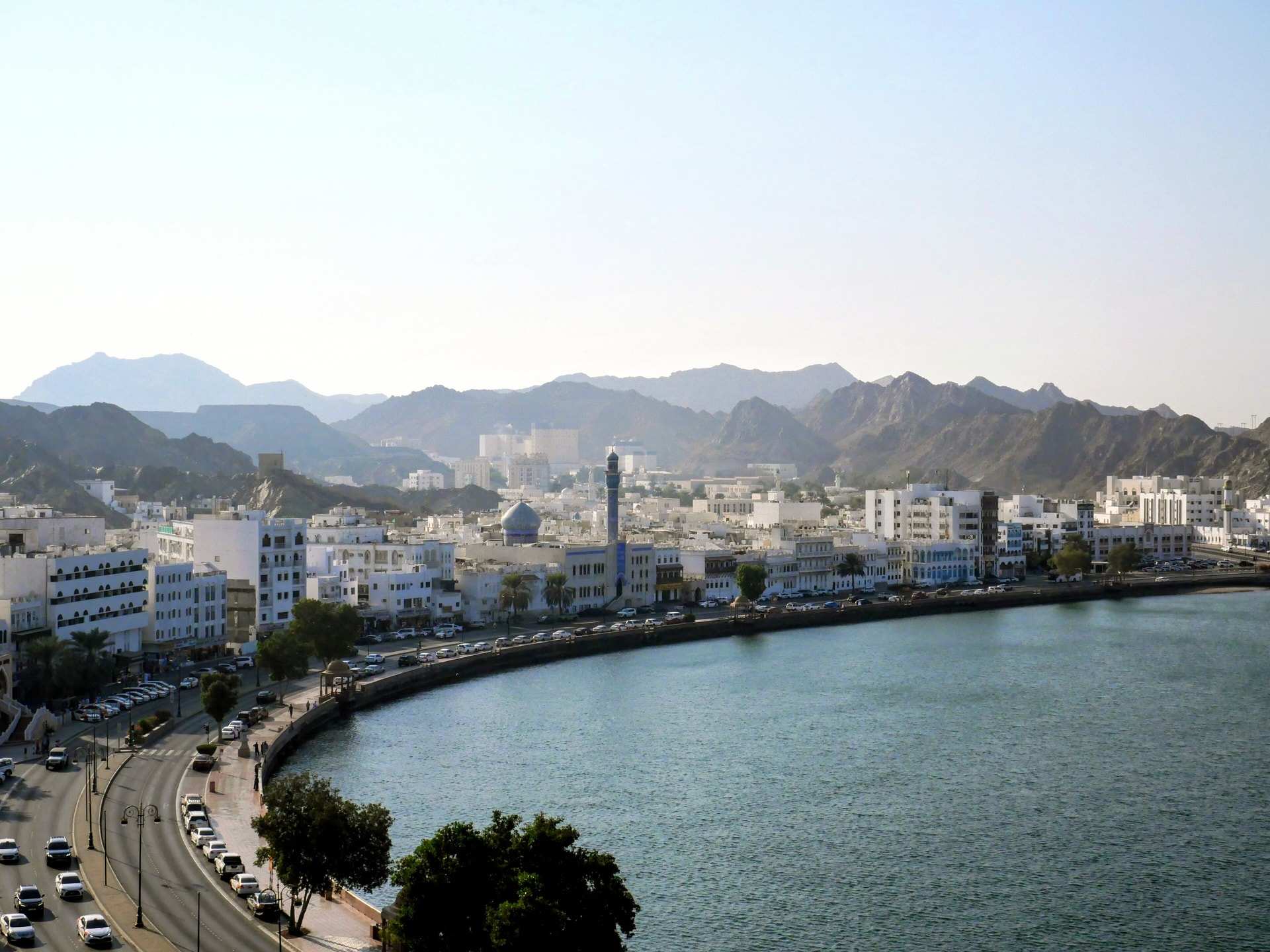
Muscat between the mountains and the sea, and the wadis and dunes beyond it.
Oman takes up the south-eastern corner of the Arabian Peninsula: 309,500 square kilometres, the third-largest country on the peninsula. Muscat, the capital, is a coastal city strung along the bays below the Hajar mountains.
If you know Zanzibar’s Omani palaces, parts of Oman will feel familiar. Arabic is the official language and English is widely spoken, and the tourism board lists Swahili among the other languages in common use.
The country suits a road trip. The mountains are about two hours’ drive from Muscat and Wadi Shab makes a day trip, so the natural order is Muscat, then the interior and the mountains, then the sands and the coast. We would give it a night or two in the mountains and at least one in the desert.
Where you’ll go
Muscat. The Sultan Qaboos Grand Mosque opens to non-Muslim visitors from Saturday to Thursday, 8am to 11am. Cover your shoulders and knees; women cover their hair too, and there is an admission fee. Muttrah is the old port: a souq that is a maze of alleys, and a corniche that curves around the harbour below Muttrah Fort. The Royal Opera House Muscat opened in 2011 as the first opera house in the Gulf, and it runs guided tours.
Nizwa and Bahla. Nizwa Fort was built in the mid-17th century, in the reign of Imam Sultan bin Saif Al-Ya’rubi, and the souq beside it is known for its handicrafts. Bahla Fort, a vast ruin of mud-brick walls and towers on stone foundations, became Oman’s first World Heritage site in 1987. The aflaj, the old irrigation channels, are listed too: five of them stand for some 3,000 still in use.
The mountains. Jebel Akhdar, the Green Mountain, is terraced farms and mild air, and in spring its rose season turns the slopes pink. Jebel Shams is Oman’s highest peak, around 3,000 metres like its neighbour. Both are up to 15°C cooler than the lowlands.
The wadis. Wadi Shab is about 170 km from Muscat airport. You cross the river by boat at the entrance, walk in to the pools, and swim through a narrow cave to reach the waterfall, so you need to be able to swim. Wadi Bani Khalid, in the Eastern Hajar, is greener, with waterfalls and natural pools.
The Sharqiya Sands. About 10,000 square kilometres of dunes, also known as the Wahiba Sands, and a favourite place to camp.
Sur and Ras al Jinz. Sur was one of the great shipbuilding towns of the Arabian Peninsula, and the Fath Al Khair maritime museum opened there in 2021. Ras al Jinz is the only place in Oman where you may legally watch turtles: endangered green turtles nest there, and the season runs from May to September, with night viewing from 9pm.
Salalah and the khareef. Dhofar, in the far south, gets the khareef from mid-June to September, when temperatures sit between 20°C and 28°C while the north bakes. The Land of Frankincense, a World Heritage site, is here: the frankincense trees of Wadi Dawkah and the old ports of Khor Rori and Al-Baleed. You reach it by road or through Salalah’s airport.
Musandam. The northern tip, on the Strait of Hormuz, is fjord country, sometimes called the Norway of Arabia. People come for the boat trips, the diving and the mountain treks.
When to go
Oman’s Foreign Ministry names September to March as the ideal time to visit, with temperatures of 25°C to 30°C. Winter, from November to early March, is the mildest stretch, and Muscat averages about 26°C. From June to August the lowlands reach 35°C to 45°C, and the mountains and Dhofar are the places to be.
Two cautions. Wadis flood suddenly after heavy rain between October and March, and Indian Ocean cyclones sometimes reach Oman in July and August.
Flights from Nairobi
The one nonstop is SalamAir’s weekly flight to Muscat. Oman Air does not fly to Nairobi. Otherwise it is one change: Emirates through Dubai, about ten hours in all by its own schedule, Etihad through Abu Dhabi, Qatar Airways through Doha, or Ethiopian through Addis Ababa. Oman is an hour ahead of Nairobi.
Practical notes
- Kenya is not on Oman’s visa-exemption lists and does not get a visa on arrival, so Kenyan passport holders apply for an e-visa before travel on the Royal Oman Police portal, evisa.rop.gov.om. Apply at least four days ahead, and have six months left on your passport. We checked this in September 2026.
- Arriving from Kenya, you need a yellow fever vaccination certificate if you are nine months or older.
- Cover the tops of your arms, and your legs to below the knee. Swimwear is fine at hotel pools and private beaches; keep it modest on public ones.
- Alcohol is served in licensed hotels, restaurants and clubs to those aged 21 and over, and drinking in public is illegal. So is bringing in e-cigarettes or vapes.
- Oman’s law does not allow unmarried couples who are not closely related to share a hotel room.
- During Ramadan, don’t eat, drink, smoke or chew gum in public in daylight, including in your car.
- The currency is the Omani rial (OMR), divided into 1,000 baisa.
- Entry requirements are confirmed for your passport before anything is held.
At a glance
Practical facts
- Plug & voltage
- G
- 240V · 50Hz
- Currency
- OMR
- Omani rial
- Time zone
- UTC+4
- (GST), no DST, 1 hour ahead of Nairobi
- Driving side
- Right
- Languages
- Arabic
- English
- SIM & data
- A TravelNet eSIM, live on landing. Or an Omantel, Ooredoo or Vodafone SIM at Muscat airport with your passport.
- Tipping
- A service charge is often already on hotel bills, so anything on top is yours to judge. Rounding up for a driver or a guide is appreciated, and small notes travel better than a card.
- Tap water
- Desalinated and treated, though bottled is what most people drink out of habit and taste. Ask your hotel about their supply.
Comparing countries? The full table puts every destination we plan side by side, and when to go does the same for the months.
Getting there
The flights for this trip are ticketed at the same desk as the rest of it: Emirates, Etihad Airways and Qatar Airways among the 66 airlines we ticket. Ask for the fare when you ask for the trip, and one person holds both.
Why go
Oman in six lines
- Muscat's Muttrah Corniche and souq, and the Sultan Qaboos Grand Mosque
- Nizwa's 17th-century fort and souq, and Bahla Fort, a World Heritage site
- Jebel Akhdar and Jebel Shams, up to 15°C cooler than the lowlands
- Swimming holes in Wadi Shab and Wadi Bani Khalid
- A night in the Sharqiya Sands, also called the Wahiba
- Green turtles nesting at Ras al Jinz, May to September
Privately crafted
There's no set itinerary here
Every Oman journey we plan is built from scratch: your dates, your pace, your route. Tell a travel designer what you have in mind.
Talk to a travel designerQuestions we are actually asked
Do Kenyans need a visa for Oman?
How long is the flight from Nairobi to Muscat?
When is the best time to visit Oman?
What currency is used in Oman?
Do I need a yellow fever certificate for Oman?
Is Oman safe for travellers?
Plan your Oman journey
One travel designer, one WhatsApp thread, start to finish. We answer within one working day.